Introduction
Artificial intelligence is no longer limited to large technology companies. Today, many AI tools for small businesses are designed specifically to help smaller teams automate repetitive work, analyze data more effectively, and improve operational efficiency.
For entrepreneurs and growing companies, the ability to reduce manual tasks while improving decision-making can provide a significant competitive advantage. AI-powered software can assist with customer support, marketing automation, financial forecasting, content creation, and workflow management.
However, the expanding number of AI tools on the market can make it difficult for business owners to determine which platforms actually provide practical value.
This article explores the best AI tools for small businesses, how they work, and how organizations can integrate them into daily operations to improve productivity and support sustainable growth.
Quick Summary
The best AI tools for small businesses help automate repetitive tasks, improve marketing performance, analyze business data, and enhance customer support. Popular options include AI writing assistants, automation platforms, CRM tools with predictive analytics, and AI-driven productivity software that streamline daily operations.
Table of Contents
What Are AI Tools for Small Businesses
AI tools for small businesses are software platforms that use machine learning, natural language processing, or predictive analytics to automate tasks and improve decision-making.
Unlike enterprise AI systems, these tools are typically:
- Cloud-based
- Subscription-based
- Designed for non-technical users
- Integrated with common business software
Many modern AI tools are embedded directly into everyday platforms such as CRM systems, email marketing tools, and productivity software.
Common capabilities include
- Automating repetitive administrative tasks
- Generating marketing content
- Analyzing customer data
- Predicting sales trends
- Improving customer support response times
Major technology companies including Google and Microsoft have integrated AI capabilities directly into productivity platforms, allowing businesses to adopt AI without building custom infrastructure.
For organizations exploring digital growth strategies, AI tools often complement broader initiatives such as those discussed in SEO Strategies for Growing Businesses and Automation Tools That Improve Business Efficiency.
Key Benefits of AI Adoption for Small Companies
AI can deliver measurable benefits even for small teams with limited resources. The main advantage is the ability to increase output without increasing headcount.
1. Automation of Repetitive Tasks
AI tools can handle repetitive tasks such as:
- Data entry
- Customer support responses
- Email sorting
- Scheduling
This allows employees to focus on higher-value activities such as strategy, product development, or customer relationships.
2. Improved Decision-Making
AI-driven analytics tools can analyze large volumes of data and identify patterns that humans might overlook.
For example:
- Predicting customer churn
- Forecasting demand
- Identifying high-performing marketing channels
Consulting firms such as McKinsey frequently highlight data-driven decision-making as a key factor in business performance improvement.
3. Cost Efficiency
AI software can reduce operational costs by automating processes that previously required manual labor.
Examples include:
- Automated bookkeeping tools
- AI-powered chatbots
- Marketing automation platforms
4. Marketing Performance Optimization
AI marketing tools can analyze campaign performance and suggest improvements such as:
- Best time to send emails
- High-performing keywords
- Audience segmentation strategies
These capabilities align with strategies discussed in Content Marketing Strategies That Drive Traffic.
Best AI Tools for Small Business Operations
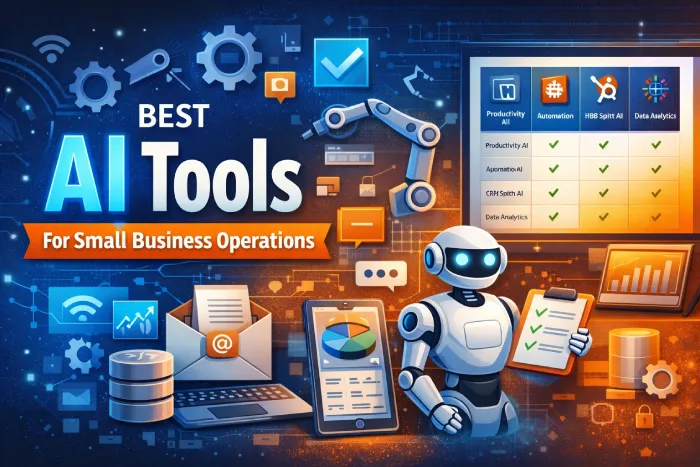
Small businesses typically benefit most from AI tools that improve daily operations.
Below is a comparison of widely used categories.
| Category | AI Tool Example | Primary Use |
| Productivity AI | Notion AI | Writing, summarization, workflow assistance |
| Automation | Zapier AI | Automating workflows between apps |
| CRM with AI | HubSpot AI tools | Customer insights and marketing automation |
| Data Analytics | Tableau AI | Business intelligence and data visualization |
| Communication | Grammarly AI | Writing assistance and communication clarity |
Productivity AI Tools
Productivity tools using AI help teams generate ideas, summarize information, and accelerate writing tasks.
Examples include:
- AI writing assistants
- Meeting transcription tools
- Document summarization platforms
These tools can significantly reduce time spent on documentation or internal communication.
Workflow Automation Platforms
Automation platforms allow businesses to connect multiple applications.
For example:
- Automatically adding leads from forms to CRM systems
- Triggering follow-up emails
- Updating internal dashboards
Automation tools are particularly valuable for small teams managing multiple digital platforms.
AI Tools for Marketing and Content Creation
Marketing is one of the areas where AI tools have become widely adopted.
AI can assist with:
- Content ideation
- SEO optimization
- Social media scheduling
- Advertising performance analysis
Common AI Marketing Tools
- AI writing assistants
Generate blog posts, product descriptions, and marketing copy. - AI SEO tools
Provide keyword insights and optimization recommendations. - AI advertising optimization platforms
Analyze ad performance and adjust targeting.
Many marketing teams use AI to accelerate content production while maintaining editorial oversight.
For businesses focused on online visibility, these tools complement strategies discussed in SEO Strategies for Growing Businesses.
Example AI Content Workflow
A small business might use AI in the following workflow:
- Keyword research using SEO tools
- AI-generated content outline
- Human editing and brand voice refinement
- AI-assisted SEO optimization
- Automated social media promotion
This hybrid model combines AI efficiency with human judgment.
AI Tools for Customer Support and Sales
Customer support automation has become one of the most practical AI applications for small businesses.
AI Chatbots
Chatbots powered by natural language processing can handle common customer questions such as:
- Order status
- Product information
- Appointment scheduling
These systems operate continuously and reduce response times.
AI Sales Assistance Tools
AI sales platforms can:
- Score leads based on likelihood to convert
- Analyze customer behavior
- Suggest follow-up strategies
CRM platforms such as HubSpot incorporate AI-driven insights that help sales teams prioritize leads.
Benefits for Customer Experience
AI support systems help businesses:
- Provide faster responses
- Maintain consistent communication
- Reduce workload on support teams
Improved customer experience often leads to higher retention and repeat purchases.
How Small Businesses Can Implement AI Successfully
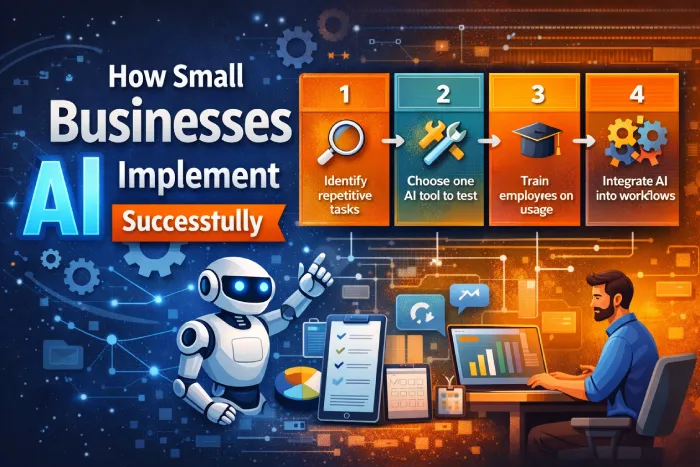
Adopting AI tools does not require a complete technological overhaul. Small businesses often succeed by implementing AI gradually.
Step-by-Step Approach
1. Identify repetitive tasks
Look for processes that consume time but provide limited strategic value.
Examples:
- Email responses
- Data entry
- Scheduling
2. Choose one AI tool to test
Start with a single platform that solves a specific problem.
3. Train employees on usage
Even simple AI tools require guidance on best practices.
4. Integrate AI into existing workflows
AI tools are most effective when integrated with existing platforms such as CRM systems or project management software.
5. Monitor performance
Evaluate whether the AI tool improves efficiency, cost savings, or revenue generation.
For startups and early-stage companies, this gradual approach aligns with strategies discussed in Startup Growth Strategies for New Companies.
Common Challenges When Adopting AI Tools
While AI offers significant benefits, businesses often encounter several challenges during implementation.
Overreliance on Automation
AI-generated content or decisions should always be reviewed by humans.
Automated outputs may lack context or accuracy in certain situations.
Tool Overload
Many businesses adopt too many AI tools simultaneously, which can create:
- workflow complexity
- software redundancy
- subscription costs
A focused toolset is typically more effective.
Data Quality Issues
AI systems depend on accurate data. Poor-quality data can lead to misleading insights or ineffective automation.
Organizations should maintain consistent data management practices.
Employee Resistance
Some employees may view AI as a threat rather than a productivity tool.
Clear communication about how AI supports — rather than replaces — employees is essential.
Expert Insight: The Growing Role of AI in Small Business Technology
Artificial intelligence is rapidly becoming a standard component of modern business software.
Research firms such as Gartner suggest that AI capabilities are increasingly embedded within everyday tools rather than offered as standalone systems.
This trend means that small businesses are likely to encounter AI features in platforms they already use, including:
- productivity software
- marketing tools
- CRM systems
- financial management platforms
As these technologies mature, AI will likely function as an invisible layer of intelligence across business operations rather than a specialized tool requiring dedicated expertise.
For entrepreneurs seeking to improve productivity, AI integration increasingly overlaps with broader digital transformation initiatives such as those discussed in Best Productivity Tools for Business Owners.
Conclusion
AI tools for small businesses provide practical ways to automate routine tasks, analyze customer data, and improve operational efficiency.
From marketing automation and content generation to customer support and workflow management, modern AI platforms allow small teams to achieve results that previously required much larger organizations.
However, successful adoption requires a thoughtful approach. Businesses should begin with specific use cases, integrate AI gradually, and maintain human oversight to ensure quality and accuracy.
As artificial intelligence continues to evolve, small businesses that strategically adopt these tools will be better positioned to scale operations, improve productivity, and remain competitive in increasingly digital markets.