Introduction
Entrepreneurs often face a common constraint: time. Running a business requires managing operations, marketing, customer communication, and strategic planning simultaneously. As companies grow, these responsibilities quickly become difficult to handle manually.
This is where AI automation tools play a significant role. These tools use artificial intelligence and workflow automation to perform repetitive tasks, analyze information, and streamline processes that would otherwise require hours of manual effort.
Instead of replacing human decision-making, AI automation tools support entrepreneurs by reducing operational friction and improving efficiency across business functions.
In this article, we examine the most practical AI automation tools available today, how they help entrepreneurs save time, and how businesses can implement them effectively within existing workflows.
Quick Answer Summary
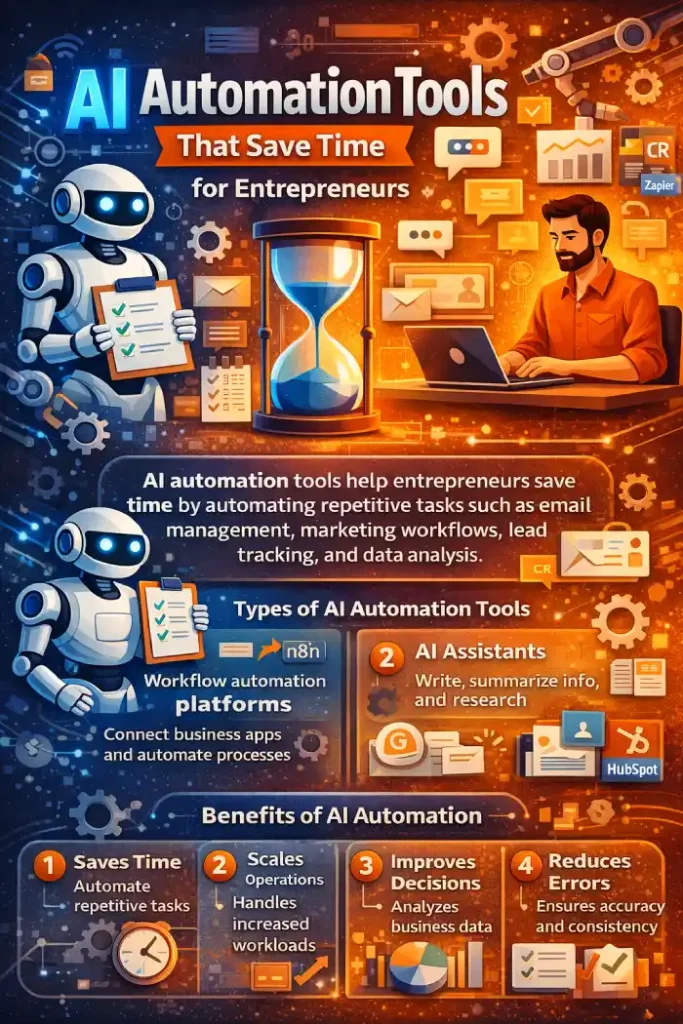
AI automation tools help entrepreneurs save time by automating repetitive tasks such as email management, customer support, marketing workflows, and data analysis. Platforms like workflow automation systems, AI assistants, and CRM automation tools streamline operations, allowing entrepreneurs to focus on strategy and growth.
Table of Contents
What AI Automation Tools Are and How They Work
AI automation tools are software platforms that combine artificial intelligence and workflow automation to perform tasks without constant human involvement.
These tools often integrate with existing business applications, including:
- email platforms
- customer relationship management (CRM) systems
- project management tools
- marketing software
- financial platforms
The core goal is to automate routine operations so that entrepreneurs can focus on higher-value work such as product development, partnerships, and strategy.
Common capabilities of AI automation tools
- automating repetitive workflows
- generating content and responses
- analyzing business data
- managing customer interactions
- scheduling and task coordination
For example, an AI automation platform can automatically trigger a follow-up email when a potential customer fills out a website form. The entrepreneur does not need to manually track or send the message.
Many modern platforms integrate machine learning and natural language processing technologies similar to those developed by companies like Google and Microsoft, which are embedding AI directly into everyday business software.
These capabilities are part of a broader technological shift discussed in BrightScope Journal’s analysis of How Artificial Intelligence Is Transforming Business.
Why Entrepreneurs Are Adopting AI Automation
The growing interest in AI automation tools is driven by several operational advantages that directly impact productivity.
Time efficiency
Entrepreneurs typically manage multiple roles within a business. AI automation reduces the time required for routine tasks such as:
- email management
- reporting
- lead tracking
- scheduling
Automating these processes can save hours each week.
Operational scalability
Automation allows businesses to handle higher workloads without increasing staff.
For instance, an automated marketing funnel can manage hundreds of leads simultaneously while maintaining consistent communication.
Data-driven decision making
AI-powered analytics tools can process large volumes of business data and highlight patterns that may not be immediately visible.
Consulting organizations such as McKinsey frequently emphasize that data-driven decision-making improves business performance and long-term competitiveness.
Reduced operational errors
Automated workflows reduce the likelihood of mistakes in repetitive processes such as:
- customer data entry
- invoice generation
- task assignment
When automation handles these tasks, consistency improves.
Types of AI Automation Tools Entrepreneurs Use
AI automation tools typically fall into several functional categories.
Understanding these categories helps entrepreneurs choose the most appropriate tools for their business needs.
1. Workflow automation platforms
Workflow automation tools connect different applications and trigger actions automatically.
Examples include:
- sending emails when a form is submitted
- updating CRM records after a purchase
- generating reports from multiple data sources
These tools act as the infrastructure connecting different business systems.
2. AI assistants
AI assistants can support tasks such as:
- writing emails or reports
- summarizing documents
- brainstorming marketing ideas
Platforms like Claude, developed by Anthropic, provide conversational AI capabilities that assist with writing, research, and analysis.
3. Marketing automation tools
Marketing automation systems allow entrepreneurs to manage campaigns with minimal manual intervention.
Typical capabilities include:
- automated email sequences
- audience segmentation
- performance analytics
Companies such as HubSpot have integrated AI features that help businesses optimize marketing campaigns.
4. Customer support automation
AI chatbots and automated support systems can handle common customer questions.
Examples include:
- order tracking
- appointment scheduling
- product inquiries
These tools improve response times while reducing support workload.
5. Data analysis and reporting tools
AI-powered analytics tools convert business data into actionable insights.
Entrepreneurs can use these platforms to analyze:
- sales trends
- marketing performance
- customer behavior patterns
Research firms like Gartner emphasize that analytics-driven organizations tend to make faster and more effective business decisions.
Popular AI Automation Platforms for Business Workflows
Several platforms are widely used by entrepreneurs seeking to automate daily operations.
Below is a simplified comparison of commonly used AI automation tools.
| Tool | Primary Function | Best Use Case |
| n8n | Workflow automation | Connecting business apps and automating processes |
| Zapier | Automation platform | Integrating marketing, CRM, and productivity tools |
| HubSpot AI | CRM automation | Managing leads and marketing campaigns |
| Notion AI | Productivity automation | Documentation, planning, and knowledge management |
| Claude | AI assistant | Writing, summarization, and research |
n8n
n8n is an open-source workflow automation platform that allows businesses to connect multiple tools and automate complex workflows.
Entrepreneurs often use n8n for:
- CRM automation
- data synchronization
- API integrations
- reporting automation
Its flexibility makes it attractive for companies with more advanced technical workflows.
Zapier
Zapier is one of the most widely adopted automation platforms for small and medium businesses.
It allows users to create “Zaps,” which trigger automated actions between apps.
For example:
- When a new lead appears in a form → automatically add it to a CRM → send a follow-up email.
HubSpot AI tools
HubSpot provides AI-enhanced CRM features that automate sales and marketing activities.
Capabilities include:
- automated lead scoring
- campaign analysis
- AI-generated marketing content
This combination of automation and analytics helps entrepreneurs manage customer relationships more efficiently.
Practical Ways Entrepreneurs Can Use AI Automation
AI automation becomes most valuable when applied to real operational workflows.
Below are practical examples of how entrepreneurs use automation tools daily.
Automating lead management
When a visitor submits a contact form:
- Lead is automatically added to CRM
- Follow-up email is sent
- Sales task is created
- Data is logged in analytics dashboard
This entire process can happen automatically.
Automating marketing workflows
Entrepreneurs can automate marketing tasks such as:
- welcome email sequences
- newsletter scheduling
- campaign performance reporting
Automation ensures consistent communication with potential customers.
Automating internal operations
AI automation tools can streamline internal processes including:
- document management
- meeting summaries
- project updates
For example, AI assistants can summarize meeting notes and generate task lists automatically.
Many of these automation strategies are explored in BrightScope Journal’s article Automation Tools That Improve Business Efficiency.
Common Challenges When Implementing AI Automation
Although AI automation tools offer significant advantages, implementation can present challenges.
Automating the wrong processes
Businesses sometimes attempt to automate tasks that require human judgment.
Automation should focus on repetitive or structured processes.
Overcomplicated automation systems
Creating too many automated workflows can make operations difficult to manage.
Entrepreneurs should prioritize simplicity and clarity when building automation systems.
Poor integration between tools
Automation tools depend on smooth integration between platforms.
Without proper integration, workflows may fail or produce inconsistent results.
Lack of oversight
AI automation should be monitored regularly to ensure accuracy and performance.
Human review remains important, particularly for customer communications or financial processes.
Expert Insight: The Future of AI Automation in Entrepreneurship
AI automation is moving toward deeper integration across everyday software platforms.
Instead of using separate automation tools, businesses will increasingly encounter AI features embedded directly into productivity software, CRM systems, and marketing platforms.
Consulting firms such as McKinsey and Gartner highlight that the next stage of automation will combine AI, analytics, and workflow management into unified digital ecosystems.
For entrepreneurs, this shift means automation will gradually become a built-in component of daily business operations rather than an optional add-on.
Businesses that develop automation capabilities early are likely to benefit from improved efficiency and scalability as these technologies continue to evolve.
Entrepreneurs interested in broader AI adoption strategies may also explore BrightScope Journal’s article Best AI Tools for Small Businesses.
Conclusion
AI automation tools provide entrepreneurs with practical ways to reduce manual work, improve operational efficiency, and manage growing workloads.
From workflow automation platforms to AI assistants and marketing automation systems, these tools allow small teams to operate with greater productivity and consistency.
However, successful implementation requires thoughtful planning. Entrepreneurs should focus on automating repetitive tasks, integrating tools effectively, and maintaining oversight of automated workflows.
As AI technology continues to evolve, automation will increasingly become a standard component of modern business operations. Entrepreneurs who understand how to use these tools strategically will be better positioned to scale their businesses and compete in increasingly digital markets.